
CASE STUDY
Shopify vs WooCommerce: 7 Key Differences for Retail Businesses
A SaaS vs Open-source comparative study and 7 critical comparison aspects (cost, features, scalability) for choosing the right platform.
AuthorZELLIO E-Commerce Team
PublishedJuli 28, 2026
Duration7 Min Read
Core Tech Stack
ShopifyWooCommercePHPLiquid
Covered Topics
#E-Commerce#Shopify#WooCommerce#Architecture
SaaS vs Open-Source: Two Completely Different Philosophies
🛍️
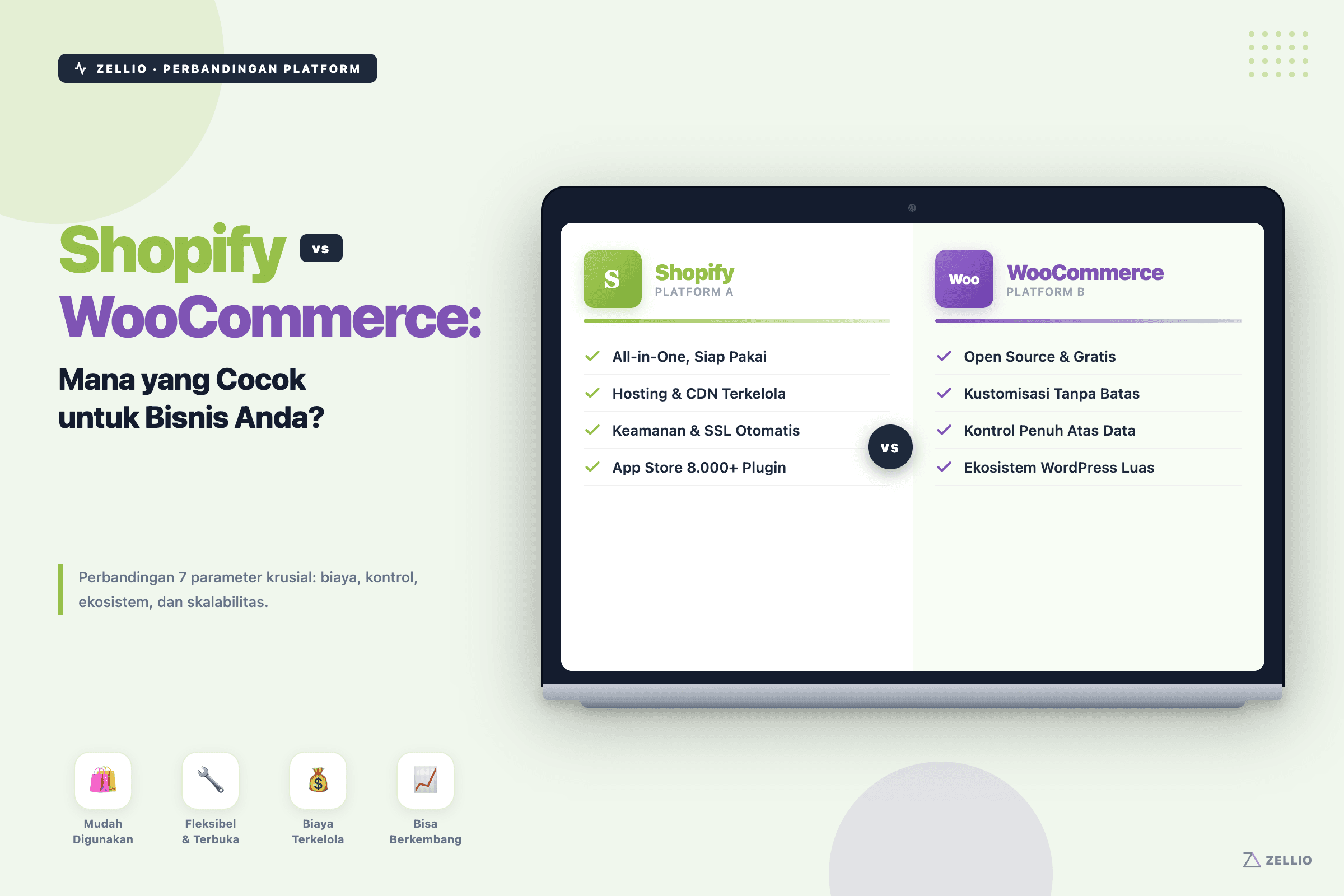
Shopify (SaaS)
- Fully managed platform
- Hosting, SSL, & security handled by Shopify
- Cost: USD 25–299/month + 0.5–2% transaction
- Ideal: D2C brands, fast launch
- Customization: limited to Liquid ecosystem
🔧
WooCommerce (Open-Source)
- Self-hosted, full technical control
- You handle hosting, SSL, & security
- Cost: hosting only (~USD 20–100/month)
- Ideal: businesses with high customization needs
- Customization: unlimited (PHP, hooks, API)
7 Key Differences That Will Determine Your Choice
- ①Cost Structure: Shopify has predictable fixed subscription costs (USD 25/month for basic). WooCommerce itself is free, but hosting, domain, premium plugins, and security certificates are self-managed expenses.
- ②Ease of Use: Shopify has an intuitive interface that non-developers can learn in hours. WooCommerce requires WordPress knowledge and some technical expertise for optimal initial configuration.
- ③Traffic Scalability: Shopify handles Black Friday traffic spikes without any additional configuration from you. WooCommerce requires manual server auto-scaling configuration to handle the same surge.
- ④Customization Flexibility: WooCommerce wins decisively. You can modify pricing logic, checkout flow, and shipping calculations down to raw PHP code level. Shopify only allows customization within its Liquid ecosystem.
- ⑤Data Ownership: With WooCommerce, all customer, transaction, and product data is stored in your own database server. With Shopify, data resides on Shopify's infrastructure and is subject to their policies.
- ⑥Plugin/App Ecosystem: The Shopify App Store has 8,000+ apps, all verified and easy to install. WooCommerce has thousands of WordPress plugins but quality varies wildly and requires independent auditing.
- ⑦Multilingual & Multi-Currency Support: Shopify Markets supports international sales with automatic currency conversion. WooCommerce requires additional plugins like WPML and WooCommerce Multilingual to achieve equivalent functionality.
"There is no universally best platform. There is only the platform most suitable for your business scale today and your expansion needs two years from now."